



THE MIGHTY VICTORIA FALLS ROARS!
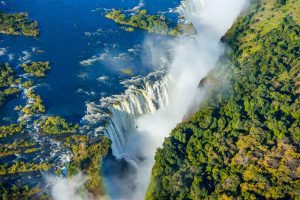 The Victoria Falls is a mixture of awe-inspiring beauty and grandeur, with columns of spray offering you a natural welcome while you are still afar off to one of the Seven Wonders of the World whose deafening roar reaches a crescendo at the height of the rainy season.
With 500 million litres of water gushing from its highest point and crashing onto its rocky belly below every minute and flowing at the rate of 1088m3/s, the Victoria Falls in Zambia is a spectacle to watch.
Everything about the Musi-oa-tunya (the smoke that thunders), as the locals call it, is a marvel to watch. It is on the Miocene beds of the Mighty Zambezi River, the fourth-longest river in Africa. The Zambezi River rises as a small bubbling stream in a jungle near Mwinilunga in the Kalene Hills, North-Western Zambia, about 1,524 meters above sea level.
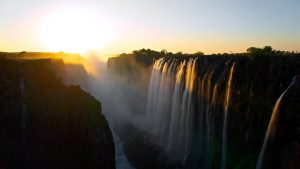
The Victoria Falls has an intersection of water current; a permanent whirlpool, which is a deep and treacherous fissure called the Boiling Point which feeds the waters to the Devil’s Cataract which is just below the bridge connecting Zambia to Zimbabwe.
At the Boiling Pot, the black basalt walls tower above you in an intimidating fashion while the roar of the Falls gives you a rumbling welcome. Here, with the current so strong, the waters of the Mighty Zambezi River are capable of sweeping you off your feet if you become carefree but it is another spectacle you cannot afford to miss.
The beautiful scenery of rumbling waters, rocks, flora and fauna instantly take you to imaginary horizons of thoughts, appreciating the beauty nature provides because since time immemorial, the Falls has remained unadulterated.
Talking about the Devil’s Cataract, this is a place where the Kololos are believed to have been making human sacrifices to their gods, an act that Missionaries condemned, calling it devilish, hence the place deriving its name from this rebuke.
In between the entrance to the falls and the Knife Bridge is the “rain forest” and a thicket which is not only home to millions of tree species but a residence to birds and animals. Here, it is up to the tourist’s choice whether to get drenched or get raincoats. Just like many places around the falls, baboons and monkeys roam free and can steal anything from food to delicate articles such as phones, hence the need for visitors to be careful and secure their property.
But the Victoria Falls is not the only gift the Zambezi River has given to Zambia. Just next to the falls is the Musi-oa-tunya National Park. This wildlife sanctuary gives you a rare opportunity to track white rhinos on foot while troops of daring vervet monkeys and chacma baboons provide constant encounters as one roams the bush.
While the best time to see Victoria Falls is January and February and June to August, elephants in reckless abundance gives a better glimpse of marvellous heads from July to September, which simply means that Livingstone City, the Tourist of Zambia, provides tourism activities all year around.
By having Game Drive in the park, you have an opportunity to see animals ranging from elephants, white rhinos, giraffes, wildebeests, buffaloes, waterbucks, impalas, zebras, bushbucks, warthogs, monkeys, baboons, hippos, and crocodiles at close range and have a memorable experience.
But that is not all that the visit to the Victoria Falls offers you. Just 3kilometres from the mighty falls is the Mukuni Big 5 Safaris, situated on top of a hill overlooking the historic town of Livingstone. Here, you enjoy a truly ultimate African bush experience by walking the King of the Beasts, the African Lion.
It is only at the Mukuni Big 5 Safaris that you can have a peaceful interaction with the fastest land mammal, the African Cheetah and then have the luxury of jumping on the jumbo (African elephant) among other exciting activities with animals and have an interaction with rhinos and caracals at the sanctuary.
THE MAMBILIMA FALLS
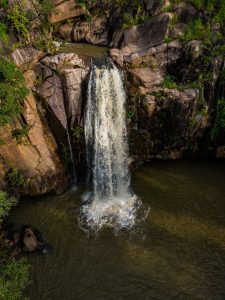 The Mambilima Falls is one of the falls found in Zambia and consists of a series of rapids on the Luapula River which extend along a 5 kilometre stretch of the river.
Below Lake Bangweulu the Luapula is a broad, swamplike system flowing southward that turns west and descends the steep Mambatuta Falls before meandering north to the Mambilima falls. The lush and densely populated Luapula valley opens out beyond the Mambilima falls into a huge area of marshes, floodplains and lagoons at the southern end of Lake Mweru. There is an almost continuous stretch of villages from the falls to the lake.
KAFUE NATIONAL PARK
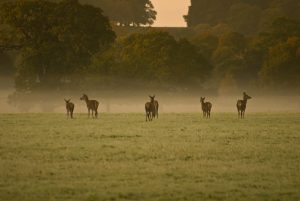 Found in the centre of western Zambia, Kafue National Park is the oldest and largest of Zambia’s national parks. It is also the second largest National Park in Africa, only beaten by the Serengeti in Kenya and covers a massive 22,400 square kilometres.
First established as a National Park in the 1950s, Kafue National Park is named after the Kafue River which meanders through most parts of this wildlife habitat, stretching up to 1,600 kilometres. The park is characterized by Savanna grasslands with islands of Miombo trees scattered across the plains. The southern part of the park is further characterized by rocky outcrops, stony hills, and mopane woodlands.
The Zambezi flooded grasslands become an ecosystem that is rich with diverse wildlife. The area becomes an excellent place to watch for wildlife while on safari.
There are 55 different mammalian species roaming about the Savanna grasslands and mopane forests. Predators are almost always the highlight and they are here in full. Lion, leopard, hyena, cheetah, and Cape wild dogs are all hopeful sightings.
Here, you will always have an encounter with popular species include bushbuck, crocodile, duiker, eland, elephant, grysbok, hippopotamus, kudu, lechwe, roan antelope, wildebeest, and zebra, with a diverse collection of antelope as well as large herds of red lechwe and puku.
The best time to visit Kafue National Park is from July to October – the middle and end of the Dry season when the bush has dried out and thirsty animals head to rivers and waterholes, which makes these the best months for wildlife viewing. The Busanga Plains are off-limits in the Wet season when they are flooded but offer an adventurous outing any time of the year.
Worried about accommodation? There are plenty of hotels and lodges within the park to suit your budget and to enable you feel the African bus life away from the noise of the city at competitive rates with finger-licking sumptuous meals and for game viewing and any other activities, there are professional tour guides that will meet all your demands.
THE KASANKA NATIONAL PARK: HOME TO THE LARGEST ANNUAL BAT MIGRATION
The Kasanka National Park is found in Chitambo District of Zambia’s Central Province. At roughly 390 square kilometres, Kasanka is one of Zambia’s smallest National Parks but holds a world record of having the planet’s largest mammal migration. As a matter of fact, the African straw-coloured fruit bat is one of the largest fruit bats on the continent.
The annual Kasanka bat migration, which happens annually between mid-October and December, is a marvel to watch and has left tourists, both local and international, reeling to witness the spectacle every year.
By the end of November, and there are at least 8 million African straw-coloured fruit bats (Eidolon helvum) filling the skies and for years, this startling sight of an animal carnival remained the natural world’s best-kept secrets as it was virtually unseen by African travel enthusiasts.
From west Africa, over the forests of the Congo basin and on to Zambia, the bats migrate thousands of kilometres over the Savanna and open land, dispersing seeds into deforested areas, and reforesting and regenerating landscapes on their journey.
Scientists are still trying to fathom why these fruit bats, or “flying foxes”, gather at Kasanka in numbers not seen anywhere else. Each night they leave their evergreen swamp fig roosts to fly up to 90 kilometres in search of wild berries and fruit.
The bats arrive around mid-October and leave towards the end of December, so the best time for guaranteed bat viewing is the whole month of November.
For those who love adventure, the Kasanka National Park gives unforgettable memories of a spectacle you will never see anywhere in the world but Zambia.
Zambia is one of the safest countries in Africa, and a 90-day visa can be obtained at both the Kenneth Kaunda International Airport in Lusaka or Harry Mwanga Nkumbula International Airport in Livingstone
THE SOUTH LUANGWA NATIONAL PARK:
If you are looking for a place in Africa with a mesmerising combination of open, grassy, and mature woodlands, with plenty of wild animals, then the serene South Luangwa National Park in Zambia is the place to visit.
Travelling to South Luangwa National Park is easy. Within an hour, you fly into Mfuwe from Lusaka’s Kenneth Kaunda International Airport from which you can easily drive into the park. Lodges will provide pickup and transportation once you arrive in Zambia at Mfuwe Airport, which is a small airport, complete with customs and immigration.
From luxurious lodges to tented bush camps, the wide variety of lodging in South Luangwa National Park offers even the most discerning traveller a comfortable place to rest after the excitement of safari. South Luangwa is also the birthplace of the walking safari – one of the best ways to get up-close-and-personal with the park’s pristine wilderness, which boasts 60 animal species and over 400 bird species. While out on the plains, visitors can view large herds of elephant, some up to 70 strong, and encounter the mighty buffalo.
The Luangwa Valley has the world’s highest naturally occurring population of leopards. Concentrations of game along the riverine area increase throughout the dry season and are at their maximum during September and October. Buffalo herds of over a thousand and large herds of elephants are frequent sightings. Hippos collect in huge numbers, often several hundred strong, in the deep-water channels of the river, accompanied by unknown numbers of Nile crocodile.
For the birdwatcher too, Luangwa could hardly be better with some 400 species of bird. The sun-scorched riverbanks play host to vast colonies of carmine bee-eaters, which together with numerous raptors, lovebirds, weavers and kingfishers lend more than a splash of colour to this beautiful destination.
NORTH LUANGWA NATIONAL PARK
Like the Luangwa South National Park, the Luangwa North National South Park, it lies on the western bank of the Luangwa River bordered on the other side by the dramatic Muchinga Escarpment which rises over 1000 meters from the valley floor. Its hazy outline can clearly be seen from the Luangwa River.
There are a number of tributary rivers running through the Park and into the Luangwa which play an important ecological role in the area. The crystal-clear Mwaleshi River trickles down the escarpment in a series of small waterfalls. It recedes in the dry season, leaving many pools along the way, drawing the animals from the bush to its banks in search of water.
There are a number of tributary rivers running through the Park and into the Luangwa which play an important ecological role in the area. The crystal-clear Mwaleshi River trickles down the escarpment in a series of small waterfalls. It recedes in the dry season, leaving many pools along the way, drawing the animals from the bush to its banks in search of water.
LUMANGWE FALLS
Near the Chipembe Pontoon, an astounding drop in the middle of nowhere, creates what looks like a smaller version of the Victoria Falls. Standing at 35 metres high and 100 metres across, the foals nourish a small rain forest on the Kalungwishi River. They are quite magnificent and well worth the b9 kilometre detour off the main road from Kawambwa to Mporokoso.
TRADITIONAL CEREMONIES
Zambia is a land of limitless tourist attractions and traditional ceremonies play a critical role in bringing people from various backgrounds to appreciate the country’s rich cultural heritage and diversity.
It boasts of 73 tribes that have co-existed peacefully since independence and with this huge number of tribes comes diversity in culture and traditions and these are showcased during traditional ceremonies which are a marvel to watch throughout the year.
Traditional ceremonies play a critical role in preserving cultural diversity and conserving biodiversity for sustainable livelihoods among Zambians and these ceremonies are an effective way of safeguarding the country’s cultural heritage and teaching good values and morals to young people.
When people come together in this way, they create a very powerful vortex of supportive and creative energy that helps them to work deeply and quickly to transform lower energies and limiting self-beliefs with powerful ease.
The major traditional ceremonies are:
The Kuomboka Ceremony
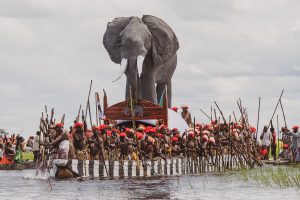 Arguably, the Kuomboka ceremony is regarded as the biggest and best known traditional ceremony in the country and is an ancient ritual of the Lozi people of Western Zambia.
The world “Kuomboka” literally means to get out of the water” as the traditional ceremony involves the movement of the Litunga, the King, from the flood Baroste plains to the higher grounds.
The Ceremony takes place at the end of every rainy season, when the upper Zambezi River plains flood and marks the movement of the people, together with the Litunga, to the higher grounds.
The Litunga is accompanied on the journey by his Prime Minister and other local area chiefs known as the Indunas. The Litunga’s boat is named “Nalikwanda” and is large enough to carry his possessions, his attendants, his musicians, his 100 paddlers, and has a large statue of an elephant – the Lozi symbol of power. The boat is painted with black and white stripes and it is considered a great honour to be one of the paddlers on the Nalikwanda.
The trip from the flood plains to the higher grounds takes between 6 to 8 hours but two days before the event around 21:00, the royal drums, the Maoma, are beaten at Lealui to summon paddlers for the Kuomboka Ceremony.
This is a special occasion as the Maoma are first beaten by His Majesty, Litunga and then members of the Royal Family led by Natamoyo, Indunas, and the general public take turns to sound the Royal drums. The Maoma are beaten non-stop until about 23:00. It is said that on a quiet night, the sound of Maoma can be heard up to 15 kilometres away.
A day before the ceremony, hundreds of people descend on Lealui, including paddlers from various parts of Barotseland. The Royal Canoeing Regatta takes place on this day where the competition is flagged off by His Majesty, the Litunga.
On the day of the ceremony at around 07:00 the Mutango, the first and oldest Royal drum, is played at Limbetelo, sending the message that the Litunga of Barotseland is set for the journey to Limulunga. At Mongu harbour, people gather to travel by various boats to Lealui through the flooded Barotse plain.
At approximately 09:30, His Majesty the Litunga, dressed in traditional Silozi kilt (sikutingo), leaves the Palace and, in keeping in tune with the Royal drums, walks majestically to Lealui Nayuma Harbour. Eulogists, the praise chanters, with very strong voices take turns in praising the Litunga.
The Litunga boards the Nalikwanda Royal Barge, usually paddled by up to 100 men. The Nalikwanda sets off followed by Notila, Matende, Mbolyanga, Sabelele, Nalikena (for the Ngambela) and hundreds of small boats and canoes.
Around 16:00 the spy boats Natamikwa and Mundende arrive before Nalikwanda docks at Limulunga Harbour where the Litunga is received by thousands of people. A display of Manjabila, Lishoma, and Maoma, are played before the Nalikwanda docks.
Men perform the Silozi Royal salute (kushowelela) while the women dance and sing limeka and liimba. The Litunga emerges from the Nalikwanda immaculately dressed in his Royal Admiral Ceremonial suit in tune with Royal drums. He walks majestically (Kutamboka) to the Royal Pavilion (Lutatai). Paddlers, like warriors, dance to Lishoma and then perform the Silozi Royal salute.
Around 21:00, the Maoma Royal drums are beaten to announce that his Majesty Litunga Lubosi Imwiko II is now in the winter capital, “Limulunga lya mulonga lya mambo kupula”.
The Kulamba ceremony
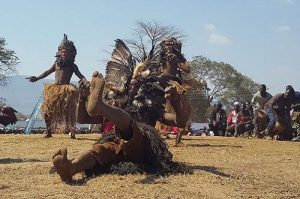 The Kulamba traditional ceremony of the Chewa people has gained significance after Zambia’s independence and is now synonymous with Chewa identity and unity.
It is held on the last weekend of August at Mkaika in Katete District in Eastern Province. The functions of the Kulamba reflect the three principal political roles held by the Chewa King:
Kalonga-one who identifies and installs others into office;
Gawa-one who allocates land, shares wealth or tribute with or among others;
Undi-one who protects citizens (ku undatira) under his wings as a bird protects its young ones.
This ceremony draws chiefs and their subjects from Zambia, Malawi, and Mozambique, as well as senior Government officials and subjects from the three countries.
The Nyau-masked dancers are a popular feature at this ceremony. These are understood to be the spirits of the dead ancestors and they perform the Gule Wamkulu (big dance) of the Chewa traditional life and it is performed by the Nyau brotherhood.
At these times the Nyau are understood to be possessed by the spirits of the mask — both animal spirits, called nyama, and the spirits of the dead or their ancestors, called mizimu — and must not be referred to as men.
Since 2005, UNESCO has protected the unique Nyau culture, designating it one of the ‘Masterpieces of the Oral and Intangible Heritage of Humanity’ which come from traditional societies all over the world.
Nyau societies operate mostly at the village level, but they are also part of a wide network of Nyau across central and southern Malawi, eastern Zambia, and western Mozambique.
The Nyau dances themselves involve intricate footwork and flinging dust in the air, and the dancers respond to specific drum beats or songs depending on their mask type and character — often also incorporating reverse role-playing, proverbs, mimicking and satire in performances.
The masks worn over the face primarily represent ancestral spirits, while the zilombo, or wild animals, are large constructions — often made from wood and straw — that cover the entire body and mostly represent animals.
The Likumbi Lya Mize
The Makishi Masquerades are a marvel to watch during this ceremony by the Luvale speaking people of North-Western Zambia which marks the successful passage of boys into manhood after undergoing a series of training for six months.
The festival is to celebrate the return of boys between 8 and 12 who had been in seclusion learning survival skills, hunting, understanding women, becoming a good spouse and father, and culminating into circumcision. The Luvale speaking people consider uncircumcised men as dirty or unhygienic.
The ‘Makishi’, who are the masked men who are believed to be spirits representing ancestors, are at the centre of attraction during the ceremony. Over 100 Makishi “resurrect” from the graveyard and then go to a dancing arena to perform dances. The boys are also kept at the graveyard where they leave their symbolic death as children when they are later collected.
The Likumbi Lya Mize traditional ceremony is a spectacular traditional event that draws tourists from within Zambia and Abroad.
The main attraction of the Likumbi Lya Mize ceremony is the Makishi Masquerades.
The N’cwala ceremony
In February each year, the Ngoni people of Eastern Province gather at Mtenguleni village for a spectacular event called the N’cwala to celebrate the new harvest. The first crops of the season are blessed by the Paramount Chief Mpezeni.
A bull is brought down using spears and blood drawn and given to Paramount Chief Mpezeni and mock fights between the impis (warriors) recreate the various battles the Ngoni fought and won during their migration from South Africa to Zambia.
Ngonis are warriors and hunters who found themselves in Zambia from South Africa through the wars of wandering or Mfecane and to date, during their ceremony, most if not all of the participants are clad in animal skins, wielding spears, clubs, shields and eagle feathers.
Ukusefya Pa Ngwena
In August every year, Mungwi District in Northern Zambia is a hive of activities for the Bemba people as they prepare and celebrate the Ukusefya pa Ngwena traditional ceremonies. Bembas are commonly regarded as forest people.
They originated from Kola, present day Angola, but moved through the thicket and settled in Zambia and the Ukusefya Pa Ngwena ceremony evokes memories of how their forefathers migrated. It is believed that on their way, they found a dead crocodile at some place and picked it as it was believed to be a good omen. To date, the crocodile is an important symbol of their lives and ceremony.
During the ceremony, the Paramount Chief Chitimukulu is escorted from his palace on a throne which is a couch with a paper mache crocodile on the front. Like other traditional festivals, Ukusefya Pa Ngwenga features dancing, drumming, singing, and consumption of traditional food and beer.
The Umutomboko Ceremony
The Umutomboko is a two-day ceremony which celebrates the advent of the Lunda and Luba people to Zambia from Kola in the Democratic Republic of Congo. It is held in the last week of July by the Lunda people in the Mwata Kazembe kingdom in the Luapula province in Northern Zambia.
People of the region gather in the Mwansabombwe village to celebrate their Lunda traditions. Originally the ceremony was a dancing and beer drinking performance after a battle with the enemy. The highlight is the Umutomboko war dance performed by the king Chief Mwata Kazembe in his traditional outfit at the end of two days of rituals of dancing and chanting, paying homage to the ancestors.
The Shimunenga Ceremony
The Shimunenga Ceremony is celebrated by the Ila people of Namwala, Southern Province as a way of paying homage to the warrior, Shimunenga, who led the tribe and their cattle to the Kafue flats after a dispute with his brother.
The three-day festival includes a day reserved for the women to sing and perform traditional dances such as ‘kukonkobela’. On the second day, the women throw sticks at the men to symbolize spears thrown at Shimunenga’s brother. The third day is a cattle drive day with cows competing to cross a section of the Kafue River. Shimunenga is held in August.